显示标签为“spatial”的博文。显示所有博文

2013年4月30日星期二

Stamen maps with spplot


Stamen maps with spplot

Several R packages provide an interface to query map services (Google Maps,Stamen Maps or OpenStreetMap) to obtain raster images from them. As far as I know, there are three packages devoted to this task: RgoogleMaps,OpenStreetMap and ggmap. The latter two are increasingly popular with a wide collection of providers.

2013年4月21日星期日

OpenStreetMap package of R - get beautiful maps


The bigest change in the new version is the addition of dozens of tile servers, giving the user the option of many different map looks, including those from Bing, MapQuest and Apple.
nm = c("osm", "maptoolkit-topo",
"waze", "mapquest", "mapquest-aerial",
"bing", "stamen-toner", "stamen-terrain",
"stamen-watercolor", "osm-german", "osm-wanderreitkarte",
"mapbox", "esri", "esri-topo",
"nps", "apple-iphoto", "skobbler",
 "opencyclemap", "osm-transport",
"osm-public-transport", "osm-bbike", "osm-bbike-german")

png(width=1200,height=2200)
par(mfrow=c(6,4))
for(i in 1:length(nm)){
 print(nm[i])
 map = openmap(c(lat= 38.05025395161289,   lon= -123.03314208984375),
   c(lat= 36.36822190085111,   lon= -120.69580078125),
   minNumTiles=9,type=nm[i])
 plot(map)
 title(nm[i],cex.main=4)
}
dev.off()


http://blog.fellstat.com/?p=356

2013年3月20日星期三

A Geospatial Modelling Approach Integrating Archaeobotany and Genetics to Trace the Origin and Dispersal of Domesticated Plants


A Geospatial Modelling Approach Integrating Archaeobotany and Genetics to Trace the Origin and Dispersal of Domesticated Plants


Background

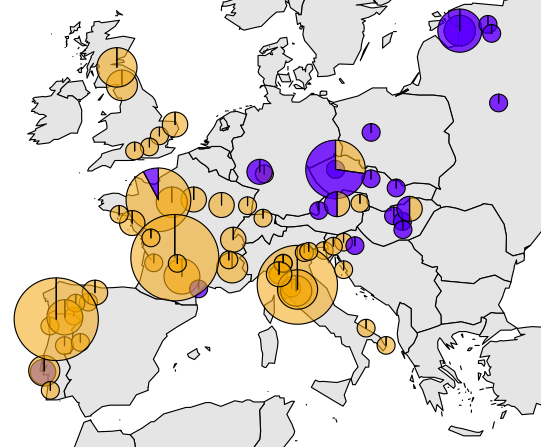
The study of the prehistoric origins and dispersal routes of domesticated plants is often based on the analysis of either archaeobotanical or genetic data. As more data become available, spatially explicit models of crop dispersal can be used to combine different types of evidence.

Methodology/Principal Findings

We present a model in which a crop disperses through a landscape that is represented by a conductance matrix. From this matrix, we derive least-cost distances from the geographical origin of the crop and use these to predict the age of archaeological crop remains and the heterozygosity of crop populations. We use measures of the overlap and divergence of dispersal trajectories to predict genetic similarity between crop populations. The conductance matrix is constructed from environmental variables using a number of parameters. Model parameters are determined with multiple-criteria optimization, simultaneously fitting the archaeobotanical and genetic data. The consilience reached by the model is the extent to which it converges around solutions optimal for both archaeobotanical and genetic data. We apply the modelling approach to the dispersal of maize in the Americas.

Conclusions/Significance

The approach makes possible the integrative inference of crop dispersal processes, while controlling model complexity and computational requirements.

van Etten J, Hijmans RJ (2010) A Geospatial Modelling Approach Integrating Archaeobotany and Genetics to Trace the Origin and Dispersal of Domesticated Plants. PLoS ONE 5(8): e12060. doi:10.1371/journal.pone.0012060

2012年8月8日星期三

Reclass ascii grid with awk


I had to reclass a large number of grids (20000+) on a server without any GIS installed.So my choice was awk.
BEGIN {FS=" ";}
 {
 if (NR < 7) print $0;
 else{
 for(i=1;i<=NF;i++)
 {
 if ($i == "-9999") res=-9999;
 else if ($i < a) res=0;
 else res=1;
 printf "%s ", res;
 } printf "\n";
 }
}

The script requires as a parameter a a threshold. Every value below this threshold is classified as 0 and every value above as 1. No data values (-9999) are not affected. Once the script is saved to reclass.awk, it can be calle with:
awk -v a=0.4 -f reclass.awk ingrid.asc > outgrid.asc

2012年6月28日星期四

chinese GIS data resources


Chinees GIS resources

Here is a list of useful Chinese GIS resources:

  1. CHGIS (download and CD)
  2. China Dimensions
  3. CloudMade (dowload)
  4. GRASS-Wiki

2012年3月21日星期三

accessions geographic locations - Arabidopsis thaliana

You could find these INFO in 149SNPFiltered folder, from this web page.